Overview
Zigbee is a wireless self-organizing and self-fixing mesh network based on the 802.15.4 radio. Zigbee aims to enable products and services to work together through standardization and testing. Zigbee is designed with backward and forward compatibility in mind. Zigbee supports sleepy end devices, allowing for long-lived battery-powered applications. For routing mostly mains-powered devices like lightbulbs are being used. Zigbee networks can include more than a thousand devices at a time.
The Connectivity Standards Alliance (CSA ) oversights the Zigbee protocol development and certification program. Standards that are approved by the CSA are published and openly available. To use any of these published standards you must be a member of the alliance. The network layer is defined in the Zigbee PRO standard, and the Zigbee Cluster library defines the Application Layer.
Network
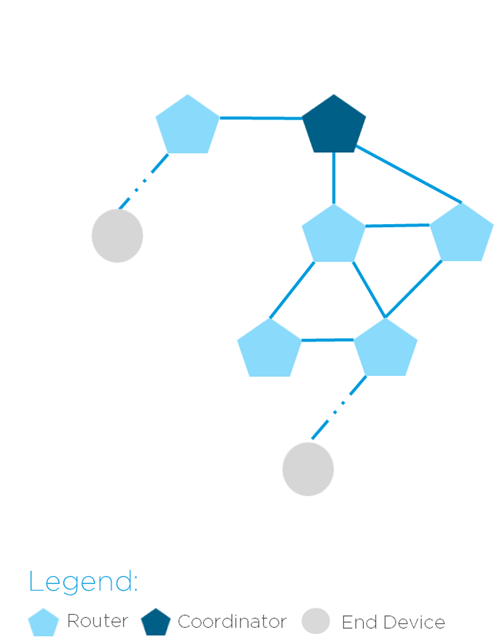 The Zigbee Coordinator handles forming a network. This is a fixed role for the lifetime of the network. There is only one coordinator in each Zigbee network. It works as a trust-center and manages security settings as well as network authorization. In its additional function as the network manager, it monitors and corrects network issues.
Zigbee routers are the core of the mesh topology. They provide routing services to connected devices. A router is the connection of its child nodes to the network. Zigbee routers are designed to have their radio continuously turned on. A router stores messages for its end devices. This means they are mostly mains connected because they never sleep. There is no limitation for the number of routers in a Zigbee network.
Zigbee end devices (ZED) are only connected to one other device, their router. A ZED can be a sleepy end device or a non-sleepy end device. Sleepy end devices are designed for low power operations. Most of the time the device will be in sleep mode. They poll their parent router to extract stored messages while awake. Non-sleepy end devices will be always powered, but still won’t rout or store messages for other devices.